Skip the manual audit — Farseek profiles your 99 and flags the gaps in seconds.
Commander is a 100-card format with no sideboard, and games go long. When something is wrong with your deck, you feel it across every turn of a 45-minute session, not just one or two. Getting your analysis right before you play saves you from spending a whole game drawing the wrong half of your deck and never quite understanding why.
The framework below is structured around the Command Zone deckbuilding template, the most widely used analytical framework in Commander, updated in 2025 (episode 658) to reflect the modern environment. It gives you concrete target numbers for every functional category. Each section below explains what the number should be, how to count against it, and what falling short actually looks like at the table.
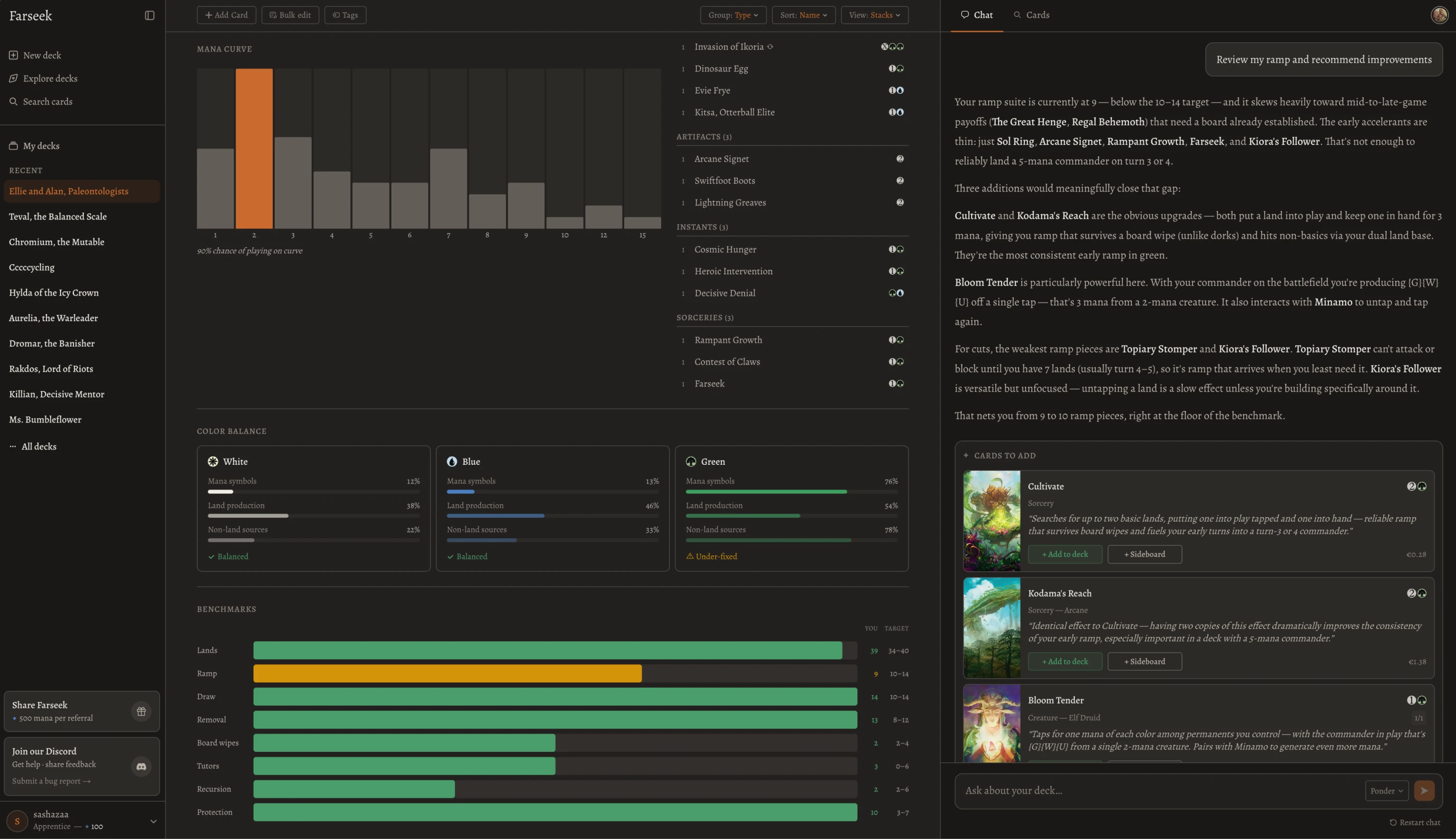
The Commander Deckbuilding Checklist: How Many Lands, Ramp, and Card Draw?
The numbers below come directly from The Command Zone's 2025 updated template (episode 658), built on probability research by Frank Karsten and Salubrious Snail. Treat them as a diagnostic baseline, not a rigid recipe. Every commander, playgroup, and power level demands adjustments. A storm deck won't run 38 lands. A landfall deck might run 42. The template's job is to give you a number to compare against so you can make informed deviations, not accidental ones.
That adds up to more than 98 non-commander slots, and that's intentional: these numbers overlap. A ramp spell that also draws a card counts toward both. A removal spell that tutors counts as disruption. The template describes roles, not mutually exclusive buckets.
The most common mistake is filling the plan slots first and treating the functional categories as optional. Every card you put in before hitting these baselines is a card you're hoping you won't miss. You will miss it.
1. Mana Foundation: Lands + Ramp
Mana problems are the most common reason Commander decks underperform, and the hardest to notice. When you're mana screwed, you blame variance rather than deck construction. But most of the time it was the deck construction.
How Many Lands Should a Commander Deck Have? (~38)
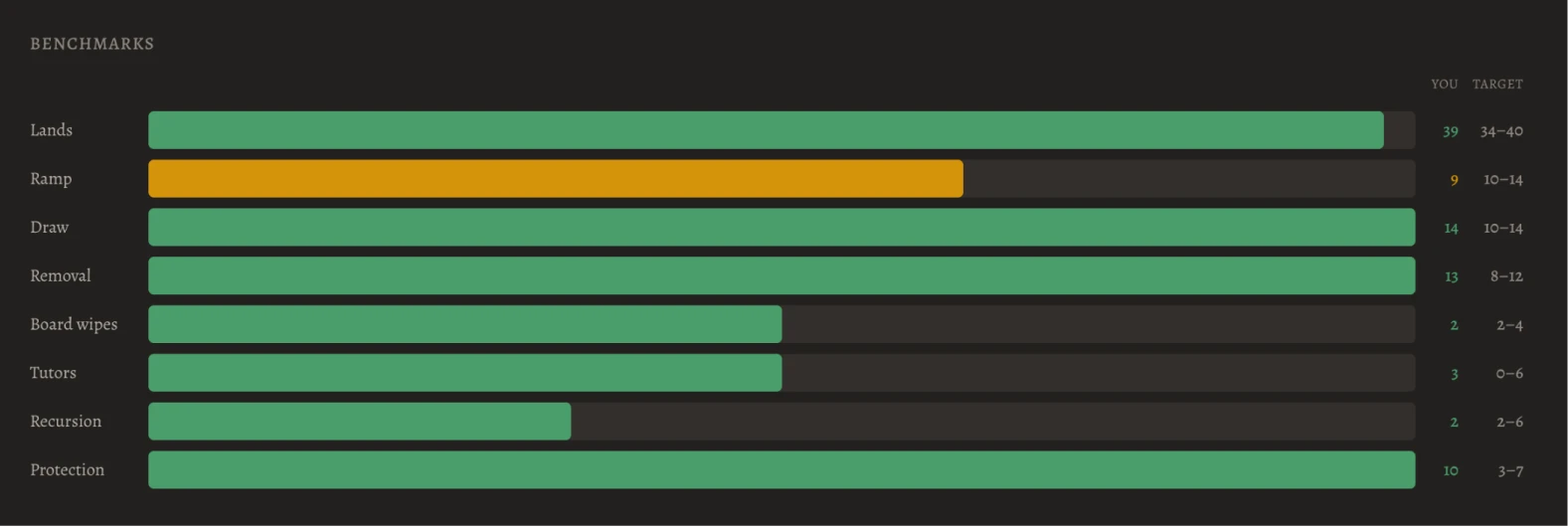
Count your actual lands, not mana rocks, not land-fetching spells. The Command Zone's updated template anchors at 38, higher than many players are used to. The reasoning is probabilistic: modern Commander games are faster, and missing early land drops puts you so far behind that no amount of synergy recovers it. The Command Zone references work by Frank Karsten and Salubrious Snail showing that hitting your first several land drops consistently requires more lands than most players run.
This doesn't mean 38 is sacred. Adjust based on your average CMC:
- Low curve (avg CMC under 2.5): 34–36 may work with a dense cheap rock package
- Mid curve (avg CMC 2.5–3.5): 36–38 is the standard range
- High curve (avg CMC 3.5+): 38–40; you need consistent land drops to function at all
How Much Ramp Does a Commander Deck Need?
Count every card whose primary purpose is getting you to more mana faster: mana rocks (Sol Ring, Arcane Signet), mana dorks (Birds of Paradise, Llanowar Elves), land ramp (Farseek, Kodama's Reach), and mana doublers. Don't count lands that tap for two. Those are lands.
The common mistake is counting conditional cards as ramp. A card that generates mana only when your commander is in play is a synergy card, not a ramp source. Be strict. When in doubt, ask: "Does this card help me cast my commander on curve if it's the only ramp I draw?"
2. Card Advantage: How Much Card Draw Should a Commander Deck Have?
Card advantage is the category players most consistently underestimate. It's easy to feel like your deck draws fine in testing, and then you hit a game where you've emptied your hand by turn 5 and spend the next ten turns top-decking while everyone else refills.
The Command Zone cites "12" as a kind of magic number in Commander: if you run roughly a dozen of any important category, you're likely to see one in your opener or early draws. Count dedicated draw sources only: spells that draw cards directly (Rhystic Study, Mystic Remora, Necropotence), repeatable draw engines (Phyrexian Arena, Guardian Project), and looters. Do not count:
- Impulse effects (exile and play): selection, not true card advantage
- Tutors: you spend a card to find one, net zero
- Combat damage draw triggers: unreliable in four-player politics
- ETB cantrips (e.g. Wall of Omens): these replace themselves but don't generate advantage
Spell-slinger and blue decks can run higher. Aggressive creature decks that naturally rebuild hand size may run a little leaner. But if you're below 10 genuine draw sources, you will run out of cards before your opponents.
3. Interaction: Targeted Disruption + Mass Disruption
Interaction is the category most players feel they have enough of, and usually don't. The pressure to include more synergy cards is always greater than the pressure to include removal. The table doesn't care about your synergy when an opponent drops an Omniscience on turn 6.
How Much Removal Should a Commander Deck Run? (~12)
This is the number that surprises people most. Twelve targeted interaction pieces means spot removal, counterspells, artifact/enchantment removal, graveyard hate, and targeted stax effects. The Command Zone's reasoning: modern Commander is full of must-answer permanents and fast combo lines. You need enough answers that you reliably draw one when you need it, not scramble hoping for it.
Also audit speed. Sorcery-speed removal is significantly weaker in multiplayer: your opponent gets a full turn cycle before you can answer. A deck with 12 removal spells that are all sorcery-speed is weaker on interaction than a deck with 8 instant-speed answers. Count your instants and sorceries separately when evaluating this.
How Many Board Wipes Should a Commander Deck Run?
Board wipes and sweepers are your safety valve against go-wide strategies and runaway board states. The Command Zone template calls for 6, which is more than most players run. This includes true wipes (Wrath of God, Damnation, Toxic Deluge), asymmetric resets (an overloaded Cyclonic Rift), and mass disruption effects that don't destroy but heavily tax the board (Ghostly Prison effects at scale).
The key distinction is disruption that resets a board state vs. disruption that answers one thing. Farewell is mass disruption even when you choose only artifacts, because it still exiles every artifact on the battlefield; a Disenchant on one artifact is targeted disruption.
4. Plan Cards: Your ~30 Slots
Once the skeleton is in place, the remaining ~30 cards are your plan: the cards that express your deck's actual identity. Tribal payoffs, combo pieces, synergy engines, win conditions, thematic role-players. These are what make your deck yours.
Ask one question about each plan card: Does this card work toward how the deck wins, or does it just look like it does? Common failure modes:
- Win-more cards: powerful only when you're already winning, useless when you need help
- Orphaned themes: cards pointing toward a strategy the deck used to run but no longer commits to
- Cards that need other specific cards: individually weak, only good in a narrow window you rarely hit
- Overreliance on the commander: if your whole plan requires your commander to have been in play for three turns, you lose to commander tax
Also check: can you state your win condition in one sentence? If the answer involves five specific cards all being in play simultaneously, you have a problem. The template's ~30 slots should contain multiple ways to execute your plan, not one fragile line that gets countered and ends your game.
5. What's a Good Mana Curve for a Commander Deck?
Category counts tell you what's in the deck. Mana curve tells you whether you can actually cast it.
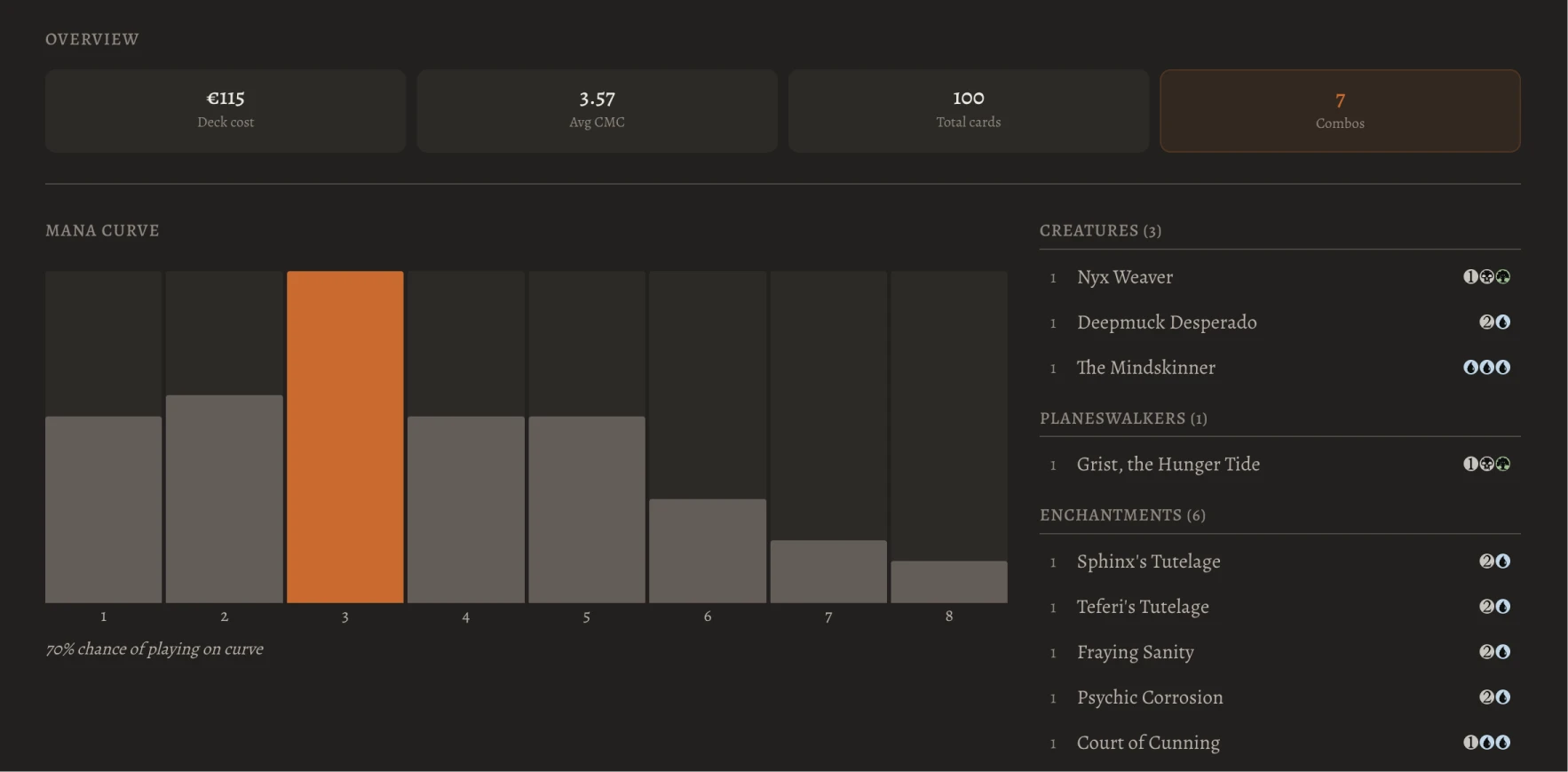
A healthy Commander curve is dense at 2–4 mana, lighter at 5–6, and contains only a handful of 7+ spells. Most of your turns 1–4 should be spent on setup (ramp, draw, cheap interaction) so you can deploy your mid-game threats and actually reach your win condition.
The Command Zone introduces the concept of a commander curve template: think specifically about when your commander realistically comes down, and build your curve around that window.
- Commander costs 3–4 mana: your 2–3 CMC slots should be full of ramp and setup that lead directly into casting and protecting it on curve
- Commander costs 5–6 mana: your early curve must be more efficient at surviving and accelerating, and you need meaningful backup plans for when it gets answered
- Commander costs 7+ mana: you're building a different kind of deck. Early curve must be exceptionally efficient, and you likely need more ramp than the baseline 10
Average CMC is the number to watch. Above 3.5 and you'll frequently have mana you can't spend effectively in the early game. Below 2.5 and you may be able to trim lands slightly, but most players go too low, not too high.
6. Color Fixing: How Many Sources Per Color Do You Need?
Land count and ramp count tell you how much mana you'll have. Color fixing tells you whether that mana is the right colors when you need it.
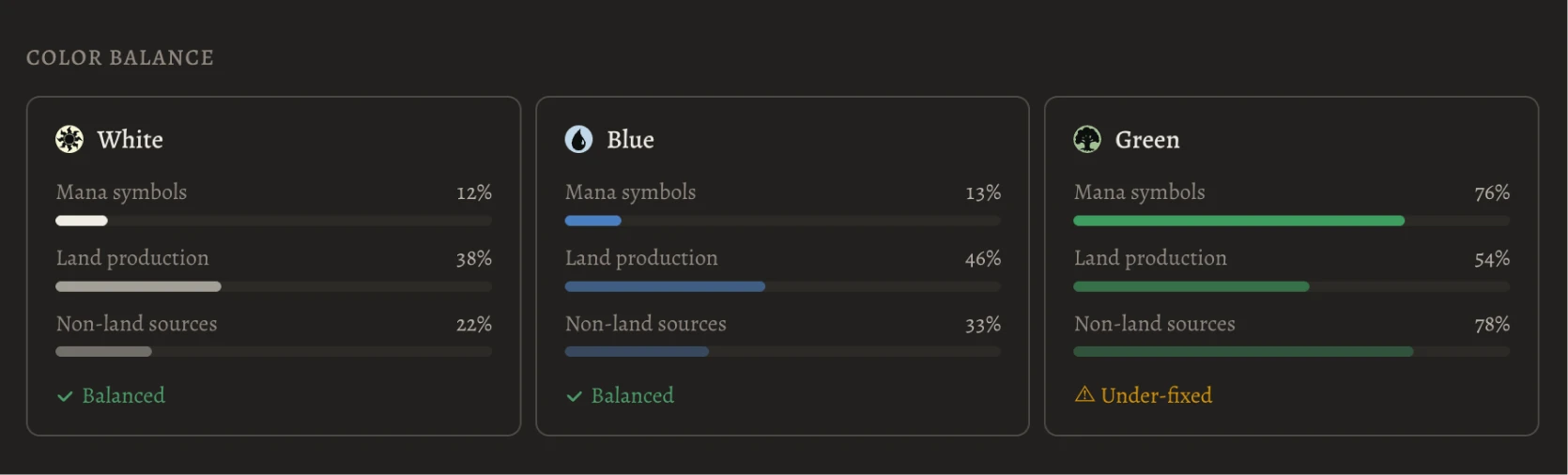
The method is simple: count how many colored mana symbols (pips) of each color appear across your casting costs, then compare that to how many sources of that color you run. A three-color deck with 20 blue pips and 8 blue sources is going to struggle. A deck with 5 green pips and 12 green sources is probably overproducing green at the expense of other colors.
Common signs of a color-fixing problem:
- Double- or triple-pip costs (like {U}{U} or {B}{B}{B}): require specific sources, not just generic mana, so check these explicitly
- Early-turn color requirements: a turn-2 play that costs {1}{W}{W} needs two white sources in your opening hand; if your mana base can't consistently produce that, the card is worse than it looks
- Off-color splash: a single card in a fourth color you have no sources for. Usually a mistake from deckbuilding drift
7. Synergy Gaps: Cards That Don't Pull Their Weight
After the quantitative checks above, the final step is qualitative. Look at each card and ask: does this earn its slot given what my deck is trying to do?
This is the hardest analysis to do on your own deck. You built it, you know every card's best-case scenario. Synergy gaps appear most often as:
- Off-theme power cards: genuinely strong cards that pull the deck's identity in a second direction
- Dead draws in specific matchups: cards that do nothing against control or nothing against aggro
- Normalised underperformers: cards you've run so long you've forgotten they rarely do anything

The Limits of Analyzing Your Own Deck
Manual analysis using the Command Zone template is genuinely useful, but it has a structural limitation: you built this deck. You know what every card is supposed to do and you've been there for every best-case scenario it's ever been involved in. That makes it genuinely hard to evaluate whether a card actually performs well on average, vs. just performs well in the games you remember.
Three blind spots that manual analysis almost never catches:
- Normalised weaknesses: cards you've run so long you've forgotten they underperform
- Conditional synergies: two cards that look like they interact well but require a third piece you don't always have
- Orphaned themes: three cards that point toward a strategy the deck no longer commits to but you haven't fully cut
Using a Commander Deck Analyzer
A Commander deck analyzer automates the category counts above and surfaces issues that are easy to miss manually. Basic analyzers handle the quantitative side: they tell you how many ramp sources you have against the target number.
An AI Commander deckbuilder goes further. Farseek loads your complete 99 into context, reads the oracle text of every card, and reasons about whether each card is actually contributing to your gameplan, not just whether it fits a category label. That's the difference between knowing you have 9 ramp sources (one short of the baseline) and knowing that three of those sources are conditional on your commander being in play, making your reliable ramp count closer to 6.
The most useful questions to ask an AI deck analyzer after running through the Command Zone framework manually:
- "What obvious upgrades am I missing for this strategy?"
- "If I want to add [card], what should I cut to make room?"
- "Any cards from the last few sets I should be considering?"
- "Which cards in here are doing the least work for what I'm trying to do?"
- "How can I make this deck faster?"
- "Is my ratio of enablers to payoffs right for the way this deck wants to win?"
- "What bracket does this deck actually play at?"
These are questions the template numbers can't answer. They require something that has read your specific 99, knows what's been printed in the last six months, and understands the gameplan you're building toward — not the average pile.
Run the analysis on your deck. Import from Moxfield, Archidekt, or paste a list.
Frequently Asked Questions
How do you analyze a Commander deck?
Analyze a Commander deck by working through seven areas: lands (~38), ramp (~10), card advantage (~12), targeted disruption (~12), mass disruption (~6), mana curve (dense at 2–4 CMC, avg CMC under 3.5), and color fixing (pip counts vs. source counts). Then look qualitatively at your ~30 plan cards and ask which ones aren't earning their slot. The Command Zone deckbuilding template (episode 658) provides the baseline numbers. Treat them as starting points, not rules.
What is a Commander deck analyzer?
A Commander deck analyzer evaluates your decklist against proven deckbuilding benchmarks, checking mana curve, ramp count, card draw sources, interaction density, and win condition consistency. Basic analyzers flag category shortfalls. AI-powered analyzers like Farseek go further: they read the oracle text of every card and reason about whether each one is earning its slot given your specific gameplan.
How many lands should a Commander deck have?
The Command Zone's updated template (episode 658) recommends 38 lands as a baseline for a normal Commander deck. Adjust down toward 34–36 for low-curve decks with a heavy mana rock package, or up toward 40 for high-curve decks or landfall strategies. The key insight from the Command Zone is that most players run too few lands. 32–34 is common, and it leads to far more mana problems than players realise.
How much card draw should a Commander deck have?
The Command Zone recommends 12 dedicated card advantage sources. This includes draw spells, repeatable draw engines, and looters, but not tutors (net zero card count), ETB cantrips (replace themselves but don't generate advantage), or combat damage triggers (too unreliable in multiplayer). Running fewer than 10 genuine draw sources consistently leads to mid-game hand drought.
What is the Command Zone deckbuilding template?
The Command Zone deckbuilding template is a framework developed by The Command Zone podcast for building consistent Commander decks. The 2025 update (episode 658) recommends: ~38 lands, ~10 ramp, ~12 card advantage, ~12 targeted disruption, ~6 mass disruption, and ~30 plan cards. It's the most widely cited deckbuilding framework in the EDH community, built on probability research showing that these numbers give you reliable access to each category in your opening hand and early draws.